ValidMind's AI Governance Play and the Visa Rule That Could Drain Your ML Pipeline
Banks are automating model documentation while a visa rule threatens to choke the talent pipeline building those models. The timing is almost poetic, and Bulgarian teams should pay attention to both.
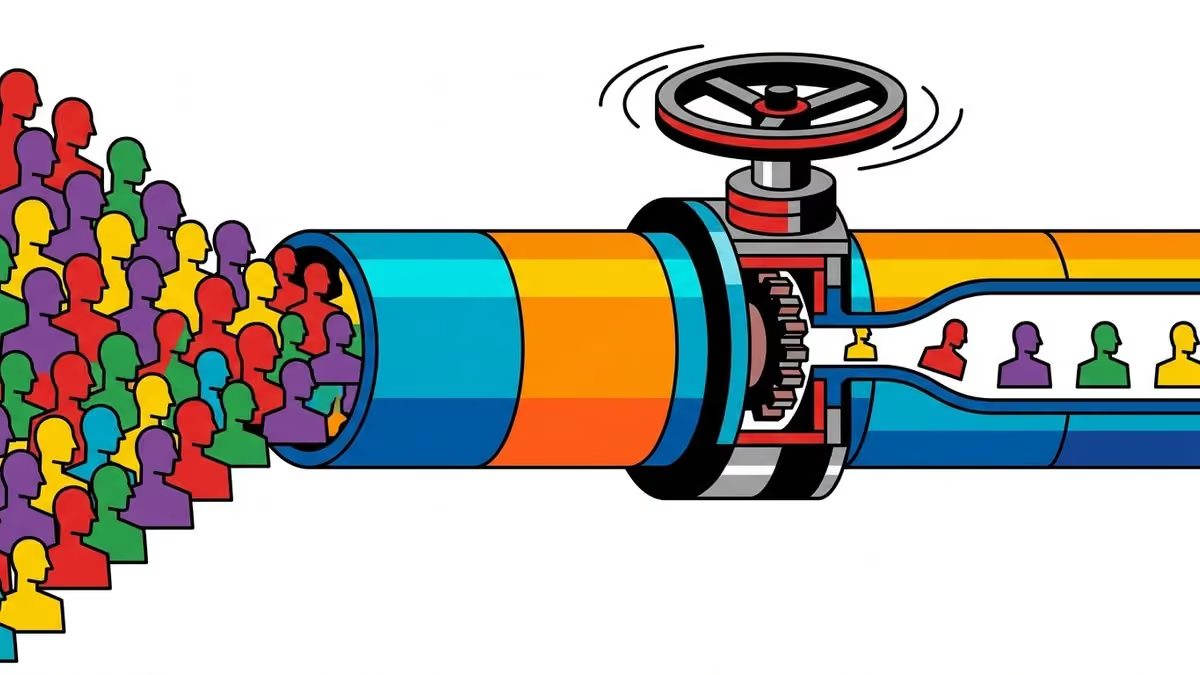
Financial Institutions Are Automating Model Risk Documentation While a Proposed Immigration Rule Threatens to Choke the Talent Pipeline That Builds Those Models
In Brief
Experian and ValidMind are deepening their partnership around AI governance automation, with ValidMind CEO Jonas Jacobi highlighting the platform’s role in helping regulated industries scale AI responsibly. Separately, the U.S. Department of Homeland Security has proposed eliminating “Duration of Status” for F-1 and J-1 visa holders, replacing it with fixed four-year admission periods.
For Bulgarian engineering teams with U.S. operations or colleagues on student visas, this creates new compliance tracking burdens and potential talent retention headaches.
Model risk management and immigration compliance will both feature in ISTA 2026 discussions this September. Speaker applications remain open until May 31 for practitioners with real implementation stories.
The Governance Automation Angle
The Experian-ValidMind partnership, announced in February 2025, targets a specific pain point: the manual documentation burden that slows AI model deployment in regulated industries. Banks, insurers, and fintechs operating under SR 11-7, SS1/23, E-23, and the EU AI Act face overlapping requirements for model transparency, validation, and audit trails.
ValidMind’s platform automates model documentation and validation workflows, integrating with Experian’s Ascend Platform for data and analytics. The pitch is straightforward: reduce the time between model development and production deployment by eliminating manual documentation bottlenecks.
At Experian’s Vision Conference earlier this month, Jacobi noted that AI’s transformative potential lies in addressing “repetitive, time-consuming tasks that employees perform every day.” Model documentation fits that description precisely. A credit risk model that takes six months to document and validate is a model that arrives late to production.
The partnership addresses a real gap. According to Experian’s Perceptions of AI Report from January 2026, nearly two-thirds of surveyed financial institution leaders identified “AI-ready data” as one of their biggest obstacles. Data quality emerged as the single most important factor influencing trust when selecting an AI partner. Governance automation without clean data is just faster documentation of garbage.
The Visa Complication Nobody Wanted
While financial institutions automate their model governance, a proposed DHS rule threatens to complicate the human side of AI development.
The proposed regulation, published in August 2025, would replace “Duration of Status” (D/S) for F-1 students, J-1 exchange visitors, and I-status foreign media representatives with fixed admission periods, generally not exceeding four years. Currently, these visa holders are admitted for the duration of their program, with their I-94 arrival record marked “D/S” rather than a specific expiration date.
The practical impact for employers: a new expiration date to track that may not align with existing work authorization documents. An employee on STEM OPT (Optional Practical Training) with a three-year Employment Authorization Document could have an I-94 that expires in two years. The work authorization document remains valid, but the underlying status does not.
Experian’s Employer Services team outlined the compliance implications in September 2025. The scenario they describe is messy: employers who only track EAD expiration dates could unknowingly employ someone who has lost lawful status. That is a compliance failure with real consequences.
The rule remains in the proposal stage. The public comment period closed on September 29, 2025, and final implementation timelines remain uncertain. But the direction is clear: more administrative burden, more tracking requirements, more potential for errors.
What This Means for Bulgaria
Bulgarian engineering teams should consider two angles here.

First, the governance automation trend. If your organization builds models for clients in regulated industries (banking, insurance, fintech), the documentation and validation requirements are tightening. The EU AI Act adds another layer. Tools like ValidMind represent a category of solutions that will become increasingly relevant. Evaluate whether your current model documentation workflows can scale, or whether automation is worth the integration effort.
Second, the visa implications. Bulgarian engineers working in the U.S. on F-1 OPT or J-1 visas, or Bulgarian companies with U.S. subsidiaries employing such workers, should monitor this rule’s progress. If finalized, it creates new reverification requirements and potential status gaps. For Bulgarian companies hiring U.S.-based talent, ask your HR or legal teams about I-94 tracking procedures. For Bulgarian engineers considering U.S. opportunities, understand that the administrative landscape is shifting toward more frequent status renewals.
The talent pipeline question is real. Danielle Goldman of Build Talent Labs noted on LinkedIn in June 2026 that the proposed changes “remove flexibility at exactly the wrong moment” for AI talent acquisition. OPT and CPT programs are how international graduates in AI and engineering bridge into the U.S. workforce. Restricting that pathway affects every company competing for ML talent.
The Uncomfortable Intersection
Here is the tension: financial institutions are investing heavily in AI governance automation to accelerate model deployment, while immigration policy changes could slow the talent pipeline that builds those models. The ValidMind partnership helps with the documentation bottleneck. It does not help with the human capital bottleneck.
Experian’s January 2026 study found that nearly nine in ten surveyed leaders believe AI will play a vital role across the entire lending lifecycle. That ambition requires people who can build, validate, and maintain those models. If the Duration of Status rule is finalized as proposed, some of those people will face more administrative hurdles, more uncertainty, and more reasons to consider opportunities outside the U.S.
For Bulgarian teams, this creates potential opportunity. If U.S. immigration policy makes it harder to retain international AI talent domestically, distributed teams and nearshore partnerships become more attractive. Sofia’s growing ML engineering community could benefit from that shift, assuming the talent development pipeline keeps pace.
Dig Deeper
- ValidMind platform documentation for technical details on model governance automation
- Fragomen’s analysis of the Duration of Status proposal and its implications
- Experian Perceptions of AI Report for survey data on AI adoption in financial services