AI Agent Governance Goes From Roadmap to Compliance Risk
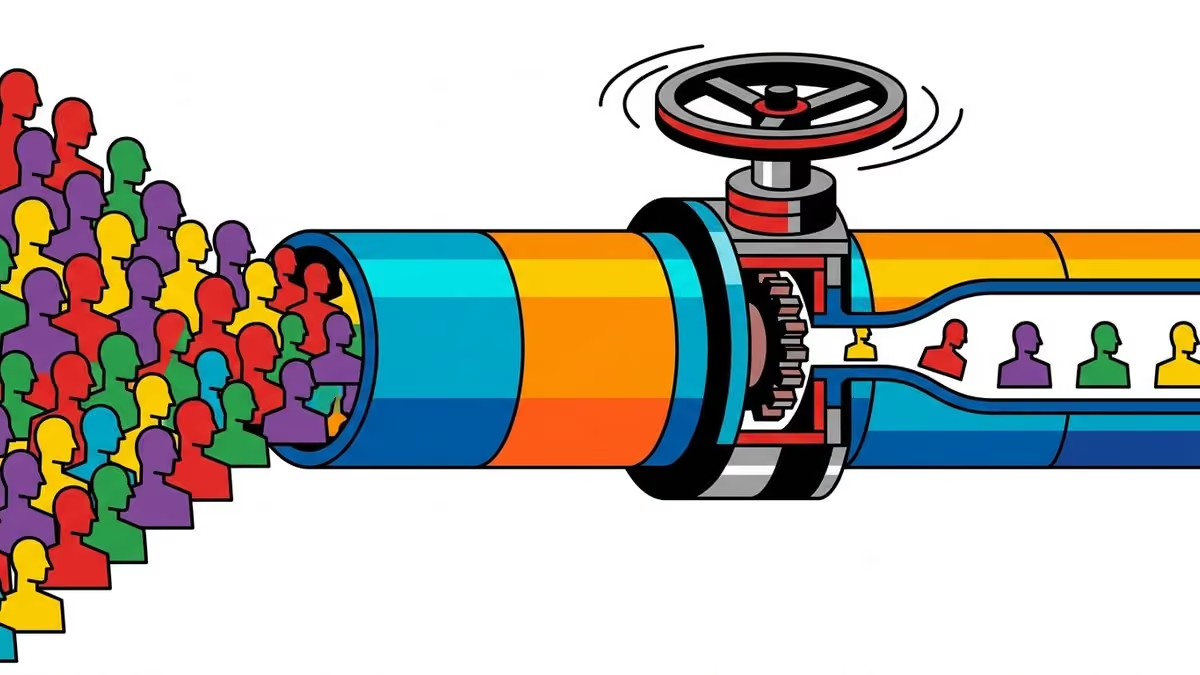
AI agents are no longer a roadmap item - they're in production, breaking things, and forcing governance conversations most organizations have been postponing. This week's announcements from SAP, DevOps.com, and the EU reveal the same underlying problem: how do you control something that acts autonomously at machine speed?

The Weekly Trend Pulse: AI Agent Governance Goes From Roadmap to Compliance Risk
The week’s signal is unmistakable: AI agents are no longer a roadmap item. They are in production, breaking things, and forcing governance conversations that most organizations have been postponing. Three separate announcements this week addressed the same underlying problem: how do you control something that acts autonomously at machine speed?
In Brief
What: This week saw major moves in AI agent governance (SAP AI Agent Hub), agent autonomy frameworks (DevOps.com), and EU AI Act enforcement timelines (provisional deal reached). OpenTelemetry Java hit stable across all three pillars, and Coder launched a model-agnostic agent platform for self-hosted infrastructure.
Why it matters: The gap between “we deployed an AI agent” and “we can explain what it did in an audit” is now a compliance risk, not a theoretical concern. Teams shipping agents without governance tooling are accumulating technical debt that will compound when regulators start asking questions.
What it means for Bulgaria and the region: Bulgarian teams building for EU clients face the December 2026 deadline for AI-generated content transparency. The provisional deal’s high-risk system delays (December 2027, August 2028) buy time, but only for teams that start documentation now.
The ecosystem companies behind these signals, including Experian, Accenture, Infragistics, and Merkle, are the same ones organizing ISTA 2026 this September, where they will be presenting these patterns on stage, not just sponsoring.
Rising: AI Agent Governance Platforms
SAP launched AI Agent Hub, a vendor-agnostic system of record for AI assets across Microsoft Entra ID, Google Agent Engine, Amazon Bedrock, Azure API Center, ServiceNow, and SAP AI Core. The platform introduces a verification workflow: discovered agents enter as “unverified,” undergo structured assessment (risk rating, compliance mappings, architecture decisions), and receive a badge that will eventually gate production deployment in Joule Studio.
This matters because most organizations cannot answer “how many AI agents do we have running?” The answer is usually “more than you think, and nobody owns the inventory.”
Rising: Autonomy Spectrum Frameworks
DevOps.com published a six-level autonomy framework for AI agents in operations: from Level 0 (observe only) through Level 5 (fully autonomous). The framework maps autonomy decisions to four factors: reversibility, blast radius, confidence/signal quality, and time sensitivity.
The practical insight is that most teams should operate at Levels 1 through 3 for now, with Level 4 reserved for narrow, well-documented actions with a proven track record. The article’s approval gate design criteria (decision-ready context, timeout plans, frequency limits) are worth stealing for any team deploying agents that touch production.
Rising: Model-Agnostic Agent Infrastructure
Coder launched Coder Agents, a platform for running AI coding agents on self-hosted infrastructure with model-agnostic orchestration. The pitch is decoupling: separate the infrastructure that runs agents from the AI models they use, avoiding vendor lock-in while centralizing control over model access, prompt management, execution policy, and observability.
Coder CEO Rob Whiteley noted that building an agent is not the hard part; running agents safely and reliably is. The platform competes with Cursor Agents (which also supports self-hosted cloud agents) and broader AI control planes like TrueFoundry and Fiddler.
Fading: Unverified AI Asset Proliferation
The “deploy first, govern later” approach to AI agents is hitting its expiration date. SAP’s AI Agent Hub announcement explicitly addresses the problem: “organizations increasingly lack visibility into which agents exist, what they do, and whether they operate safely.”
The shift toward structured verification workflows signals that shadow AI is becoming as unacceptable as shadow IT was a decade ago. Teams that have been spinning up agents without inventory tracking should expect uncomfortable conversations with compliance.
Fading: Binary Human-in-the-Loop Thinking
The framing of “human in the loop vs. fully autonomous” is too coarse for production use. The DevOps.com framework makes this explicit: real deployments need granular autonomy levels, not a binary switch.
The old pattern of “always require approval” creates approval fatigue; the new pattern of “never require approval” creates audit nightmares. The middle ground requires actual engineering: confidence-gated autonomy, reversibility mapping, and approval gates designed to be used rather than bypassed.
Tool Change: OpenTelemetry Java Reaches Stable Across All Pillars
OpenTelemetry Java now shows stable status for traces, metrics, and logs. This is the “all green” moment for Java shops that have been waiting to standardize on OTel. The documentation includes a “Getting Started by Example” path that promises telemetry in under five minutes, plus JMX metrics collection for legacy MBean instrumentation.
For SRE teams running Java microservices, the practical implication is that the “wait for stability” excuse is gone. If your observability stack still relies on vendor-specific agents, the migration path is now well-documented.

Tool Change: Azure Red Hat OpenShift Adds Confidential Containers and Workload Identity GA
Microsoft and Red Hat announced Confidential Containers on Azure Red Hat OpenShift for hardware-backed isolation of sensitive workloads, plus general availability of Managed Identities and Workload Identities. The identity changes standardize credential management across platform operations and application workloads using OIDC federation, eliminating long-lived secrets in code or configuration.
For regulated industries, the Banco Bradesco case study (200+ AI initiatives, unified governance) provides a reference architecture. The OpenShift Virtualization feature also offers a migration path from legacy virtualization platforms without immediate rearchitecting.
Tool Change: EU AI Act Provisional Deal Sets New Enforcement Dates
The EU Parliament and Council reached a provisional agreement amending AI Act timelines. High-risk AI obligations originally due August 2026 are now split: December 2027 for standalone high-risk systems (biometrics, critical infrastructure, education, employment, law enforcement, border management) and August 2028 for high-risk systems embedded in products.
The deal adds a ban on AI systems generating non-consensual intimate content and CSAM (compliance by December 2026) and sets December 2026 as the deadline for AI-generated content transparency and watermarking. The agreement still requires formal approval before August 2026.
Incident Lesson: The Inventory You Do Not Have Is the Risk You Cannot Manage
SAP’s AI Agent Hub announcement contains an implicit postmortem: organizations deploying AI agents across multiple platforms (Microsoft, Google, Amazon, ServiceNow, SAP) discovered they could not answer basic governance questions. Which agents exist? What do they do? Who approved them?
The failure mode is not a single incident but a systemic blind spot. The lesson is that agent discovery and inventory must precede agent deployment at scale. Teams that skipped this step are now retrofitting governance onto systems that were never designed for it.
What This Means for Bulgaria
Bulgarian teams building AI systems for EU clients should mark December 2026 for content transparency requirements and start documenting AI-generated outputs now. For teams interviewing at SAP, Accenture, or other ISTA ecosystem companies, ask about their AI asset inventory practices and verification workflows.
Sofia-based SREs running Java microservices should evaluate OpenTelemetry migration this quarter; the “stable across all pillars” status removes the last technical objection. If your organization has deployed AI agents without a central registry, raise this with your compliance lead before someone else does.
Dig Deeper
- OpenTelemetry Java Getting Started - Step-by-step instrumentation guide for Java applications, including auto-instrumentation and manual SDK setup.
- Coder Agents Documentation - Architecture overview and deployment guides for self-hosted AI coding agent infrastructure.
- EU AI Act Compliance Tracker - Interactive tool for assessing which AI Act obligations apply to your systems and when.
- Azure Red Hat OpenShift Workload Identity Guide - Configuration walkthrough for OIDC federation and managed identity setup.
This Week’s Take
The week’s theme is “governance catches up to deployment.” Every major announcement addressed the same problem: AI agents are already running, and the controls are being built after the fact. The teams that will sleep well in 2027 are the ones building inventory and verification workflows now, not the ones explaining to auditors why they cannot list their own AI assets.
Many of the patterns covered in the Content Hub will take center stage at ISTA Conference this September, where practitioners and tech leaders discuss them live, debate the trade-offs, and put them in the context of the latest industry shifts. Stay tuned for the program announcement.