Remote MCP Servers Hit Production: What Smartsheet and Cypress Cloud Reveal About the Pattern's Maturity
MCP servers just went from local experiments to production infrastructure. Smartsheet saved 3 billion tokens, Cypress shipped GA in two months. Here's what the pattern looks like when it actually works.

The Model Context Protocol (MCP) has graduated from developer-machine experiments to remote, production-grade infrastructure. Two recent implementations, one from Smartsheet for enterprise work management and one from Cypress for test debugging, demonstrate that the pattern is now mature enough for teams to adopt without waiting for the next specification revision.
In Brief
MCP servers are moving from local developer setups to remote, enterprise-hosted deployments. Smartsheet’s AWS-based MCP server saved over 3 billion tokens through AI-specific optimizations, while Cypress Cloud MCP reached general availability in May 2026, giving AI assistants direct access to test failure data. For Bulgarian teams evaluating agentic AI infrastructure, these implementations provide concrete reference architectures for connecting AI agents to existing enterprise systems without building custom integrations from scratch.
If this pattern interests you, ISTA 2026 in September is already scheduling sessions on agentic AI infrastructure. Speaker applications close May 31, and the organizers are explicitly looking for practitioners with production experience, not slide-deck tourists.
Pattern Name: Remote MCP Server Architecture
Why This Is Important: The pattern has moved from Emerging to Adoptable. Two major vendors shipping production implementations with documented token savings and security models means teams can now evaluate MCP for their own systems with real reference architectures, not just specification documents.
Domain: DevOps / Architecture / AI
Who Should Care: DevOps/SRE, Backend, Security, Manager
Level: Intermediate
Evidence Type: Case Study / Release
The Problem
AI agents need structured access to enterprise data, but most systems were built for human users, not autonomous software. The traditional approach requires custom integrations for every model-tool pair. Connect 20 AI models to 20 enterprise systems, and the math produces up to 400 custom connectors. Each integration requires its own authentication flow, data transformation logic, and maintenance burden.
The friction compounds when agents need to act, not just read. An AI assistant that can query a project management system is useful. One that can update tasks, create sheets, and manage workspaces is transformative. But granting that level of access through ad-hoc API integrations creates security and governance nightmares that most enterprise security teams will reject outright.
What Changed
Two production implementations shipped within months of each other, each solving different aspects of the same problem.
Smartsheet built a remote MCP server on AWS that connects AI clients to its work management platform. The architecture uses AWS Fargate for stateless containers, Amazon Kinesis Data Streams for change-event ingestion, and Amazon Bedrock for LLM inference. The server exposes Smartsheet’s existing APIs through an AI-optimized interface designed to minimize token cost and reduce hallucination risk.
Cypress shipped Cloud MCP as a remote server that gives AI coding assistants direct access to test run data. The implementation reached general availability on , and is included on every Cypress Cloud plan at no additional cost. The server uses OAuth authentication and exposes tools for querying run statuses, failure details, error messages, stack traces, and flaky test reports.
Both implementations share a critical architectural choice: the MCP server runs remotely, not on the developer’s machine. This shifts the security boundary from individual workstations to centrally managed infrastructure where enterprise controls can be enforced consistently.
Why Now
Three forces converged to make remote MCP servers viable in 2026.
First, the protocol itself matured. Anthropic donated MCP to the Linux Foundation’s Agentic AI Foundation in , with backing from AWS, Google, Microsoft, OpenAI, Bloomberg, and Cloudflare. The specification now includes OAuth support, streaming, and the primitives needed for enterprise deployment. SDK downloads hit approximately 97 million per month by early 2026, according to enterprise adoption data.
Second, token economics forced optimization. Smartsheet’s internal telemetry shows over 3 billion tokens saved through their AI-specific optimizations. The savings come from filtering tool outputs at the server level, returning only the fields agents actually need rather than complete API responses. Cloudflare’s Code Mode approach demonstrates similar gains, reducing the token footprint of interacting with over 2,500 API endpoints from more than 1.17 million tokens to roughly 1,000 tokens.
Third, security teams started demanding centralized control. A Cloud Security Alliance survey from found that 47% of organizations reported a security incident involving an AI agent, with 58% indicating detection and response took five hours or longer. Remote MCP servers address this by placing authentication, authorization, and audit logging at a single enforcement point rather than distributing trust across individual developer machines.
The New Practice
The pattern that emerges from these implementations has three layers.
Gateway Layer
Requests pass through an API gateway with WAF, DDoS protection, and OAuth validation before reaching the MCP server. Smartsheet’s architecture uses AWS WAF, AWS Shield, and Application Load Balancer. Cypress uses OAuth discovery with browser-based sign-in flows. Both approaches ensure that agent requests are authenticated and authorized before any data access occurs.
Server Layer
The MCP server itself runs as stateless containers that can scale horizontally. Smartsheet uses AWS Fargate for Amazon ECS. The server translates MCP tool calls into API requests against the underlying system, applies any AI-specific optimizations (field filtering, response compression, schema simplification), and returns results in the format the protocol specifies.
Intelligence Layer
Both implementations add AI-specific logic beyond simple API proxying. Smartsheet’s server includes optimizations to help prevent hallucination and reduce token cost. Cypress’s server focuses on the two questions that matter most after a test run: “Do I need to fix something?” and “Where do I start?” The intelligence layer is where vendors differentiate, turning a generic protocol implementation into a product that actually helps users.
Tooling Implications
Teams evaluating MCP adoption face a build-versus-buy decision that the new implementations clarify.
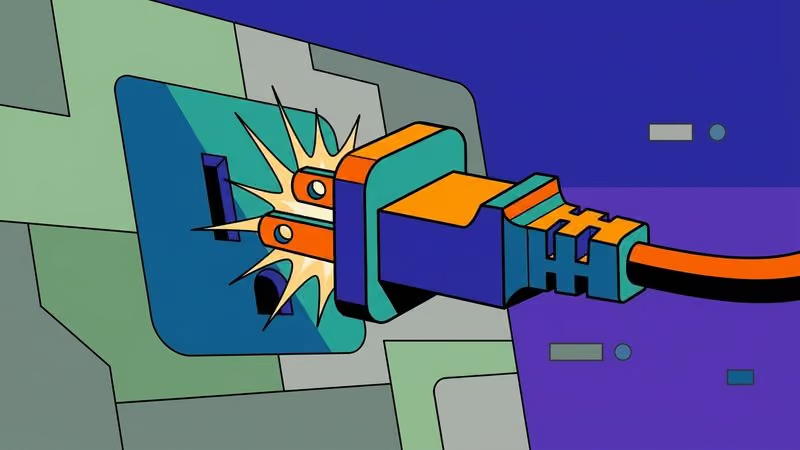
For systems where a vendor already provides an MCP server (Smartsheet, Cypress, Notion, Salesforce, and others), the integration path is straightforward: configure the remote server URL, authenticate via OAuth, and start using the tools. The vendor handles security, scaling, and maintenance.
For internal systems, the reference architectures provide blueprints. Smartsheet’s AWS-based approach is documented in detail, including the specific services used at each layer. Teams can replicate the pattern using their preferred cloud provider’s equivalents.
The tooling ecosystem has also matured. ToolHive’s MCP Optimizer acts as a smart broker between AI assistants and MCP servers, reducing token waste by filtering which tools get injected into each prompt. CData Connect AI provides a universal MCP interface for enterprise data sources with built-in optimization features. These tools sit between the AI client and the MCP servers, adding governance and cost control without requiring changes to either endpoint.
Evidence
Smartsheet’s 3 billion token savings figure comes from internal telemetry, not a controlled benchmark, but the magnitude is consistent with what other implementations report. Cloudflare’s Code Mode achieved a 99.9% reduction in token footprint for their API surface. CData’s benchmark showed a 97.6% reduction in token usage for federated enterprise queries.
The Cypress implementation provides a different kind of evidence: adoption velocity. Cloud MCP went from beta announcement in to general availability in , a two-month cycle that suggests the underlying pattern was already well understood. The feature shipped on every Cypress Cloud plan at no additional cost, indicating the company views it as table stakes rather than premium functionality.
Enterprise adoption data from The Agentics shows 28% of Fortune 500 companies have deployed MCP servers, with 80% deploying active AI agents in production workflows. The gap between those numbers (80% using agents, 28% using MCP) represents the integration debt that remote MCP servers are designed to eliminate.
Failure Modes
The pattern has known failure modes that teams should plan for.
Token bloat from tool definitions: Every MCP tool definition gets injected into the model’s context window on every request. Connect five servers with 30 tools each, and the LLM receives 150 tool definitions before reading the actual prompt. Anthropic’s engineering team documented workflows where tool definitions and intermediate results consumed over 150,000 tokens. The mitigation is progressive discovery: use a search tool to find relevant tools first, then load only those definitions.
Scope violations: A Cloud Security Alliance survey found that 53% of organizations report AI agents exceed intended permissions occasionally or sometimes. The mitigation is least-privilege access enforced at the MCP server layer, not the agent layer. The server validates permissions before executing any tool call.
Shadow MCP servers: Only 24.4% of organizations have full visibility into which AI agents are communicating with which systems, according to Gravitee’s 2026 survey. Teams deploy MCP servers without security review, creating invisible entry points. The mitigation is centralized MCP server registration and monitoring, treating MCP endpoints like any other API surface that requires governance.
Self-healing gone wrong: Cypress’s cy.prompt() feature includes self-healing capabilities that automatically adapt to UI changes. The dev.to analysis documents a failure mode where self-healed selectors target wrong elements, causing tests to pass while testing the wrong things. The mitigation is human review of healed tests before they become the new baseline.
Metrics to Track
Teams adopting remote MCP servers should instrument the following:
- Token cost per tool call: Measure the actual token consumption of each MCP interaction, including tool definitions, prompts, and responses. Compare against baseline API integrations to validate the optimization claims.
- Tool call success rate: Track the percentage of MCP tool calls that complete successfully versus those that fail due to authentication errors, permission denials, or server errors. Target above 99% for production workloads.
- Time to first tool call: Measure the latency from agent request to first MCP tool invocation. Remote servers add network latency compared to local implementations. Establish baselines and alert on degradation.
- Permission scope violations: Log and alert when agents attempt tool calls outside their authorized scope. The rate of attempted violations indicates whether your permission model matches actual usage patterns.
- Agent attribution coverage: Track the percentage of MCP tool calls that can be attributed to a specific human initiator. The Cloud Security Alliance survey found only 15% of organizations report that 76-100% of agents have defined ownership. Target 100% attribution for compliance-sensitive workloads.
Do This Next Sprint
- Inventory your AI agent integrations. List every system your AI agents currently access and how they authenticate. Identify which integrations are custom-built versus using standard protocols.
- Check for existing MCP servers. Review whether your key vendors (project management, testing, CRM, databases) already offer MCP servers. Cypress, Notion, Salesforce, and others have shipped implementations.
- Evaluate token costs. If you’re running AI agents in production, measure your current token consumption per workflow. The 3 billion token savings Smartsheet reports came from optimizations that any MCP implementation can apply.
- Audit agent permissions. Document what each AI agent can access and whether those permissions are enforced at the agent level or the system level. Plan migration to server-side enforcement.
- Prototype one integration. Pick a single system and implement or configure an MCP server for it. Measure the integration effort against your previous custom approach.
What This Means for Bulgaria
Bulgarian teams building AI-powered products face the same integration challenges as everyone else, but with additional considerations around data residency and vendor availability.
For teams using AWS, Smartsheet’s architecture is directly replicable in the eu-central-1 (Frankfurt) region, which provides acceptable latency for Sofia-based deployments. The specific services (Fargate, Kinesis, Bedrock) are all available in Frankfurt.
Cypress Cloud MCP is a remote service hosted by Cypress, so data flows through their infrastructure. Teams with strict data residency requirements should review Cypress’s data processing agreements before enabling the integration. The OAuth authentication flow means credentials are validated by Cypress’s servers, not stored locally.
For internal systems, the pattern provides a path to AI-enable legacy applications without rewriting them. Bulgarian enterprises with older systems can build MCP servers that wrap existing APIs, gaining AI agent compatibility without touching the underlying codebase.
Engineers interviewing at companies adopting agentic AI should ask about MCP adoption plans. The question “How do your AI agents authenticate to internal systems?” reveals whether the company has thought through the security implications or is running agents with ad-hoc credentials.
Dig Deeper
- Smartsheet MCP Architecture on AWS (AWS Machine Learning Blog, July 2026): The primary source for Smartsheet’s implementation details, including the specific AWS services used and the token optimization approach.
- Cypress Cloud MCP Documentation (Cypress Docs, July 2026): Official documentation for configuring and using Cypress’s MCP server, including OAuth setup and available tools.
- The Enterprise MCP Guide 2026 (The Agentics, July 2026): Comprehensive analysis of MCP adoption patterns, security gaps, and governance requirements for enterprise deployments.
- Enterprise AI Security Starts with AI Agents (Cloud Security Alliance, April 2026): Survey data on AI agent security incidents, permission violations, and governance gaps.
- Cloudflare Code Mode MCP Server (InfoQ, April 2026): Technical breakdown of Cloudflare’s approach to reducing MCP token costs through code execution.