P2P Model Distribution, Context Engineering, and the 24-Point Confidence Gap
Infrastructure is finally catching up with AI ambitions - P2P model distribution cuts origin traffic by 99.5%, context engineering replaces prompt engineering, and self-maintaining knowledge layers solve the documentation decay problem. But the week's biggest signal? A 24-point confidence gap between executives and employees that will break more AI rollouts than any technical limitation.
Weekly Trend Pulse: P2P Model Distribution, Context Engineering, and the 24-Point Confidence Gap
The week’s signals point to infrastructure catching up with AI ambitions - and organizations discovering that the hardest problems aren’t technical at all.
Rising: P2P Acceleration for AI Model Distribution
Dragonfly, the CNCF Graduated project originally built for container image distribution at Alibaba scale, now natively supports Hugging Face and ModelScope URLs. The math is compelling: distributing a 130 GB model (think DeepSeek-V3) across 200 GPU nodes drops origin traffic from 26 TB to approximately 130 GB - a 99.5% reduction.
The new hf:// and modelscope:// protocols eliminate the URL-rewriting gymnastics that previously made P2P distribution of model artifacts painful. For platform teams managing ML infrastructure at scale, this shifts model distribution from “rate-limit roulette” to “actually predictable.”
Rising: Context Engineering Over Prompt Engineering
The distinction between prompt engineering and context engineering is crystallizing into architectural guidance. Adi Polak’s analysis at QConAI frames the shift: prompt engineering treats LLM interactions as stateless, while context engineering builds stateful systems with persistent memory and coordination.
The practical implication is that techniques like role assignment (“You are an experienced backend engineer…”) are becoming less effective as models mature, while managing what context gets loaded - and keeping long-term knowledge separate from session memory - becomes the differentiator. Teams building agentic systems should expect their architecture patterns to look more like event-driven workflows than request-response APIs.
Rising: Self-Maintaining Knowledge Layers for AI Agents
Meta’s engineering team documented a pattern that deserves attention: using AI agents to pre-compute context files that encode tribal knowledge, then having those same agents maintain the knowledge layer over time. The results across their 4,100+ file codebase: 100% AI context coverage (up from 5%), 50+ documented “non-obvious patterns,” and 40% fewer tool calls per task.
The “compass, not encyclopedia” principle - 25-35 lines per context file, under 0.1% of a modern model’s context window - offers a concrete template. The self-refresh mechanism (automated jobs validating file paths, detecting coverage gaps, re-running quality critics) addresses the decay problem that makes most documentation useless within months.
Fading: Prompt Engineering as a Standalone Discipline
The rapid evolution of LLM capabilities is making many once-standard prompt engineering techniques obsolete faster than practitioners can learn them. Role assignment, few-shot examples, and chain-of-thought prompting are increasingly handled by the models themselves or by specialized tooling.
The emerging pattern treats prompting as a component of broader context engineering rather than a discipline in its own right.
Fading: Static Platform Architectures
Accenture’s research on platform strategy in the agentic AI era reports that 94% of leaders expect change and 57% call for reinvention of their platform foundations. The shift from platforms as “efficiency engines” to platforms as “AI orchestration layers” is forcing architects to rethink where AI lives, how it connects to data, and how its actions are governed.
Organizations aligning AI, platform, and business strategies report 2.2x revenue growth and 37% EBITDA lift compared to peers.
Tool Change: Dragonfly dfget with Native Model Hub Protocols
Dragonfly’s dfget tool now supports hf:// (PR #1665) and modelscope:// (PR #1673) protocols for direct P2P-accelerated downloads from Hugging Face and ModelScope hubs. Commands like dfget hf://deepseek-ai/DeepSeek-R1/model.safetensors -O /models/DeepSeek-R1/model.safetensors work without URL rewriting or wrapper scripts.
Authentication, revision pinning, and recursive repository downloads are supported. Verdict: production-ready for teams hitting rate limits or egress costs on large model deployments.
Tool Change: Envoy Extensions for Agentic AI Protocols
Google Cloud’s technical guidance on Envoy for agentic AI networking positions the proxy as the enforcement layer for MCP (Model Context Protocol) and A2A (Agent-to-Agent) traffic. The key architectural shift: policy attributes now live inside message bodies (JSON-RPC payloads), not headers, requiring proxies to parse content for governance decisions.
For regulated industries deploying agentic workloads, this provides a path to enforce GDPR/NIS2 compliance at the network layer rather than in application code.
Tool Change: Google Ironwood TPUs with 3.7x Carbon Efficiency
Google’s seventh-generation TPU, Ironwood, demonstrates 3.7x improvement in Compute Carbon Intensity (CCI) compared to TPU v5p, measured in January 2026. The gains come from 5x improvement in utilized FLOPs, widespread adoption of Mixture of Experts (MoE) architectures, and FP8 precision formats.
For platform teams tracking sustainability metrics alongside performance, the CCI framework (CO2e/FLOP including Scope 1, 2, and 3 emissions) offers a standardized measurement approach.
Incident Lesson: The 24-Point Confidence Gap Will Break Your AI Rollout
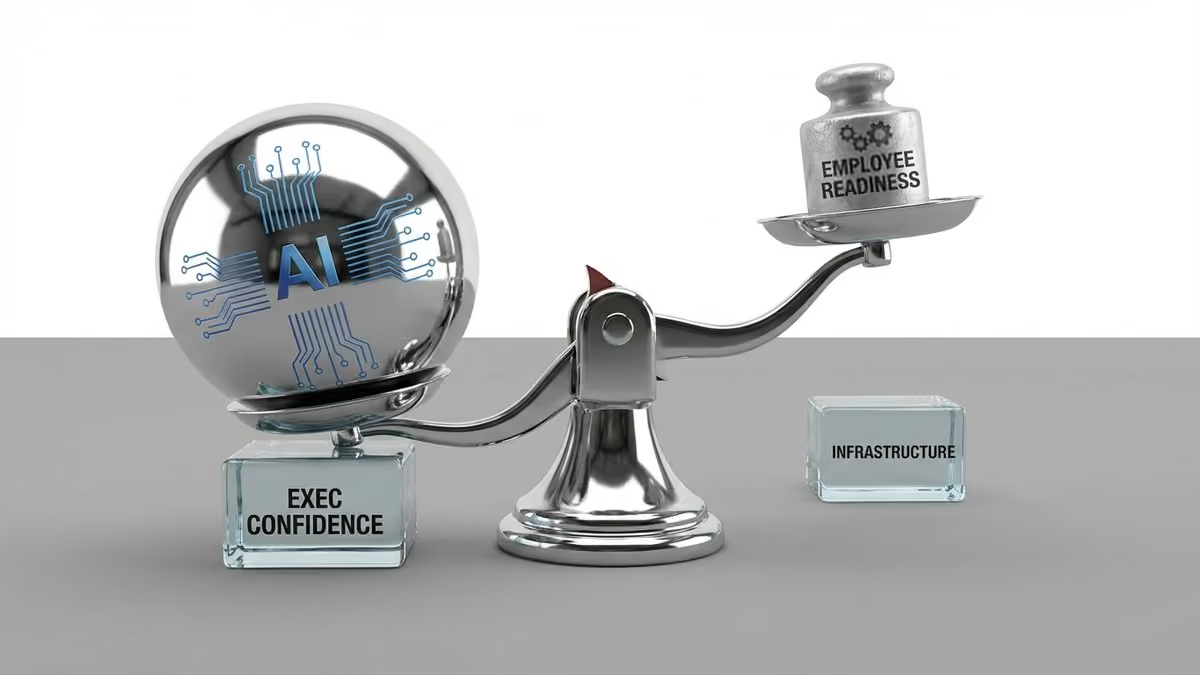
Accenture’s Pulse of Change research (3,650 C-suite executives, 3,350 workers, November-December 2025) reveals a structural failure mode: 82% of C-suite leaders expect higher change in 2026, while only 38% of workers believe their organization can respond effectively to technological disruption. Job security sentiment dropped 11 percentage points to 48%.

The data shows 43% of employees say clear training would give them more confidence with AI tools, yet only 20% feel like active co-creators in how AI changes their work. The lesson: AI adoption failures in 2026 will increasingly trace back to communication and trust gaps, not technical limitations.
What This Means for Bulgaria
The P2P model distribution pattern is immediately relevant for Bulgarian ML teams hitting Hugging Face rate limits - the Dragonfly approach works regardless of cloud region. The Envoy guidance on agentic AI governance matters for fintech and healthcare organizations preparing for NIS2 compliance, where network-layer enforcement provides audit trails that application-level controls cannot.
The confidence gap data should concern any engineering leader planning AI-driven workflow changes: Bulgarian tech teams are not immune to the 24-point sentiment divergence between executives and practitioners. For those who want to benchmark these patterns against peers, ISTA 2026 in September is where Bulgarian engineers compare notes in person - speaker applications are open until May 31.
This Week’s Take
The week’s clearest signal: the hardest AI problems are no longer about making models work - they’re about making organizations work with models. Infrastructure is catching up (P2P distribution, context engineering, self-maintaining knowledge layers), but the 24-point confidence gap between executives and employees suggests that 2026’s AI failures will be blamed on technology while being caused by communication.
Many of the patterns covered in the Content Hub will take centre stage at ISTA Conference this September, where practitioners and tech leaders discuss them live, debate the trade-offs, and put them in the context of the latest industry shifts. Stay tuned for the programme announcement.