Experian's March Small Business Index Holds Steady at 49.2: What the Flat Line Tells Engineering Teams About Client Risk
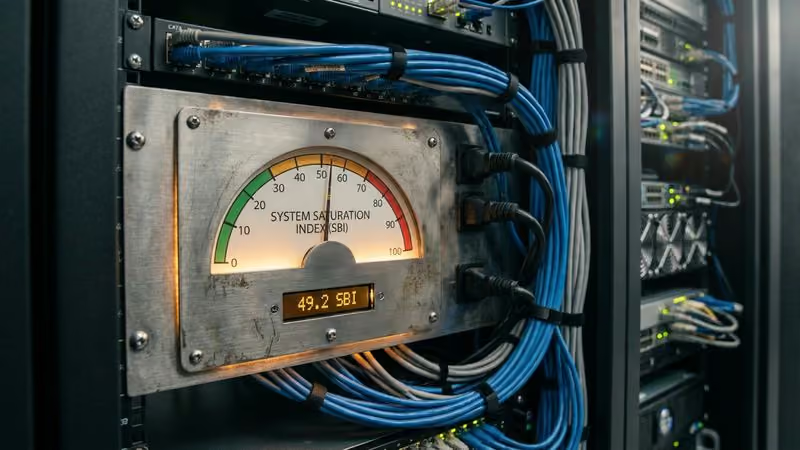
Experian's Small Business Index held steady at 49.2 in March despite inflation jumping to 3.3% and fuel costs spiking 36%. For engineering teams serving small business clients, this stability masks underlying stress that will affect payment cycles, feature priorities, and churn patterns in the months ahead.

The Experian Small Business Index (SBI) for March 2026 landed at 49.2, a 0.4-point uptick from February that barely registers as movement. For engineering teams building B2B products, payment systems, or anything touching small business clients, this flat line carries more signal than a dramatic swing would. Stability in the index masks a volatile underlying environment: inflation jumped to 3.3% from 2.4%, gasoline prices spiked 36% month-over-month, and consumer sentiment dropped to 53.3. The fact that the index held steady despite these headwinds suggests small businesses are absorbing shocks rather than thriving through them.
In Brief
Experian’s Small Business Index edged up 0.4 points to 49.2 in March 2026, reflecting relative stability despite inflation rising to 3.3% and fuel costs jumping 36% in a single month. The index remains 2 points above March 2025, but the broader picture shows businesses weathering pressure rather than expanding. For Bulgarian engineering teams serving US or EU small business clients, this signals heightened sensitivity to payment terms, pricing changes, and service reliability in the months ahead.
These macroeconomic signals and their downstream effects on software delivery will be dissected at ISTA 2026 this September, where early bird tickets remain available.
The Numbers Behind the Stability
The March 2026 SBI report from Experian paints a picture of resilience under pressure. Unemployment held at 4.3%, GDP grew 2% in Q1, and private employers added approximately 62,000 jobs. New business formation remained strong at 492,000 applications in March alone.
But the stress indicators tell a different story. Diesel prices rose 52% year-over-year. The Small Business Optimism Index dropped to 98.8. Consumer sentiment fell from 56.6 to 53.3. Retail sales held stable to slightly higher, which in economic terms means consumers are spending on necessities while cutting discretionary purchases.
The January 2026 index hit 54.3, an 8.5-point jump that coincided with inflation dropping to 2.4% and improved credit access. February saw a 5.5-point decline. March’s near-flat reading suggests the index is finding a new equilibrium somewhere in the high 40s, well below January’s optimism but not in freefall.
Why Engineering Teams Should Care
Small business health directly affects software companies in three ways: payment reliability, feature prioritization, and churn risk.
Payment cycles stretch when margins compress. The SBI tracks overdue balances and delinquency rates as core components. When fuel costs eat into operating margins, small businesses delay vendor payments. Engineering teams building invoicing, subscription, or payment processing features should expect increased demand for flexible payment terms, grace periods, and automated dunning sequences that preserve relationships rather than accelerate collections.
Feature requests shift toward cost reduction. The January SBI report noted increased demand for and access to new credit alongside declining utilization. Small businesses are borrowing to maintain operations, not to expand. Product teams should anticipate requests for cost-tracking dashboards, usage-based pricing options, and features that demonstrate ROI in concrete terms. The era of nice to have feature adoption is pausing.
Churn patterns follow sentiment, not revenue. Consumer sentiment at 53.3 represents a psychological state, not just an economic one. Small business owners making decisions under stress prioritize vendors they trust and cut those they view as expendable. Engineering teams maintaining B2B products should audit their reliability metrics, support response times, and communication clarity. The next six months will reward vendors who feel essential.
The Enforcement Overlay
Running parallel to economic pressure, 2026 has emerged as an enforcement year for employment compliance. Experian’s employer services analysis highlights three converging pressures: I-9 audits with three-day production timelines, wage-and-hour recovery exceeding $1.5 billion between 2021 and 2023, and expanding pay transparency requirements across multiple states.
For engineering teams, this creates product opportunities and compliance obligations. HR tech products need audit trail capabilities that can produce documentation within 72 hours. Payroll systems require transparency features that comply with California’s SB 1162, Colorado’s 2024 amendments, and Washington’s 2025 notice-and-cure provisions. The 76% error rate on paper I-9 forms cited in the report represents a clear automation opportunity for document management systems.
The DHS remote examination procedure, permanent since August 2023, requires E-Verify integration, live video interaction, and proper form marking. Engineering teams building onboarding systems should verify their E-Verify API integrations handle the alternative procedure checkbox correctly. A missed checkbox during an ICE audit creates liability that no amount of good intentions will resolve.
What This Means for Bulgaria
Bulgarian engineering teams serving US small business clients face a specific risk profile. The SBI’s stability masks regional variation that the national index obscures. Teams should:
- Ask clients about their geographic concentration. The Experian Metro Business Pulse historically shows significant variation between regions. A client base concentrated in high-cost areas like California faces different pressure than one serving Midwest markets.
- Audit payment terms in existing contracts. If contracts specify Net-30 and clients consistently pay Net-45, the gap will widen under economic pressure. Renegotiating terms proactively preserves relationships better than escalating collections later.
- Review US employment compliance features. Bulgarian teams building HR or payroll products for US markets should verify I-9 workflow compliance, pay transparency reporting capabilities, and audit trail retention periods. The enforcement environment has shifted from best practice to active liability.
- Check currency exposure. The BGN (Bulgarian Lev) is pegged to the Euro, but US small business clients pay in dollars. A stressed client base combined with currency fluctuation creates compound risk. Finance teams should model scenarios where 10-15% of receivables extend beyond normal terms.
The Agentic Commerce Angle
Experian’s April 2026 announcement of Agent Trust, a human-to-agent binding service for AI-driven commerce developed with Visa, Cloudflare, and Skyfire, signals where the company sees small business infrastructure heading. The service addresses a gap that becomes critical as AI agents handle more purchasing decisions: verifying that an agent has authority to commit funds on behalf of a business.
For engineering teams building AI agent capabilities, this creates an integration consideration. Agent-to-agent commerce requires trust verification that current OAuth and API key models do not adequately address. The Agent Trust framework suggests a future where B2B transactions include agent identity verification as a standard step. Teams building procurement, purchasing, or vendor management features should track this space.
Dig Deeper
- Experian Small Business Index March 2026 Report: Full methodology and state-level breakdowns
- 2026 Enforcement Priorities for Employers: I-9, wage theft, and pay transparency compliance details
- Experian January 2026 SBI Analysis: Context for the January spike and subsequent decline
This Week’s Take
The SBI’s flat March reading is the economic equivalent of a patient whose vital signs have stabilized but who remains in the ICU. Small businesses are not collapsing, but they are not expanding either. For engineering teams, this means the next two quarters will reward products that reduce costs, demonstrate clear ROI, and maintain reliability under pressure. The enforcement overlay adds compliance features to the priority list. Teams that treat this as a wait and see period will find their clients have already made decisions by the time the index moves decisively in either direction.
Many of the patterns covered in the Content Hub will take centre stage at ISTA Conference this September, where practitioners and tech leaders discuss them live, debate the trade-offs, and put them in the context of the latest industry shifts. Stay tuned for the programme announcement.