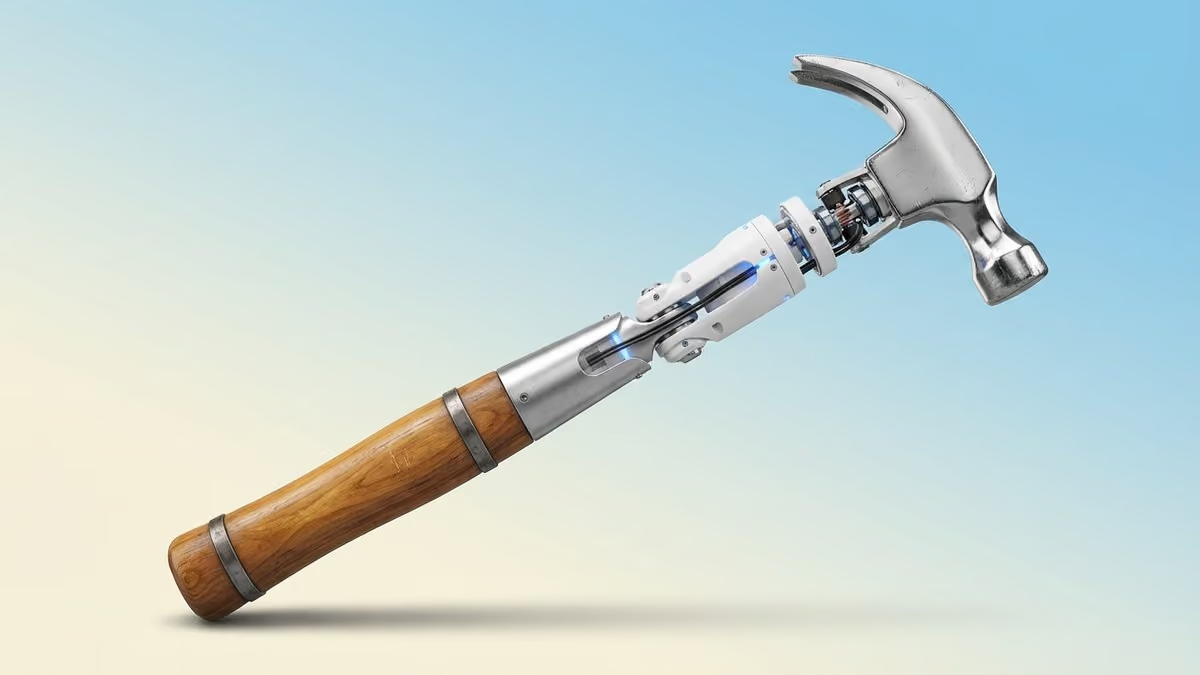
AI Infrastructure Maturation: From Feature to Foundation
AI is graduating from experimental feature to production infrastructure, with Cypress AI eliminating test maintenance overhead and Meta's autonomous agents delivering 5x engineering output. The teams treating AI integration as an engineering discipline are pulling ahead while others debug RAG pipelines by hand.

The week of March 17, 2026 delivered a concentrated dose of AI-assisted tooling announcements, production-grade architecture case studies, and a clear signal that policy-as-code is no longer optional for platform teams. The pattern emerging across these developments is unmistakable: AI is moving from experimental assistant to embedded infrastructure component, and the organizations succeeding are those treating AI integration as an engineering discipline rather than a feature checkbox.
Rising: AI-Assisted Test Maintenance
Cypress has shipped a comprehensive AI feature set that addresses the single most tedious aspect of end-to-end testing: keeping selectors alive when the UI changes. The Cypress AI documentation reveals cy.prompt() for natural language test generation, Studio AI for UI exploration, and – critically – automatic adaptation to UI changes that would otherwise break selectors.
The practical implication is significant: teams spending 30-40% of QA cycles on test maintenance now have a path to reclaim that time. The feature set is woven into existing workflows rather than requiring a separate tool, which dramatically lowers adoption friction.
Rising: Model Context Protocol for CI/CD Integration
The Cypress Cloud MCP integration represents a broader pattern worth tracking: using the Model Context Protocol (MCP) as a “USB port for AI” that connects coding assistants directly to CI/CD data. This eliminates the context-switching tax where engineers manually copy test failures into Claude or Cursor.
The MCP server provides real-time access to run statuses, flaky test identification, and failure details including Test Replay links. For teams already using AI coding assistants, this is the missing bridge between “AI helps me write code” and “AI helps me understand why production is angry.”
Rising: Autonomous ML Experimentation Agents
Meta’s Ranking Engineer Agent (REA) delivered 5x engineering output in its first production rollout, with three engineers shipping improvements across eight models – work that historically required two engineers per model. The key distinction from typical AI assistants: REA is autonomous and persistent, running experiments end-to-end rather than helping with individual steps.
It maintains context across long-running jobs, debugs failures, and iterates without human re-engagement. This is the clearest signal yet that AI agents are moving from “helpful copilot” to “independent contributor” in ML workflows.
Fading: Manual RAG Pipeline Debugging
The Rabobank case study from QCon London confirms what production teams have suspected: most RAG (Retrieval-Augmented Generation) failures stem from indexing and retrieval, not the language model. The team built a pipeline combining multiple parsing strategies – Docling for complex layouts, Azure Document Intelligence for tables, and GPT-4o for infographics – because single-tool approaches consistently failed on enterprise documents.
The era of “just embed your PDFs and call it done” is ending; production RAG requires document-type-aware parsing pipelines with explicit quality gates.
Fading: Certification-Only AI Training
Atos’s AWS AI League case study documents the gap between theoretical AI knowledge and practical application. Despite 5,800 AWS certifications, the organization found that hands-on, gamified learning was necessary to achieve actual AI fluency.
The 400+ participant program used competitive, experiential challenges rather than passive coursework. For engineering leaders planning AI upskilling, this is a clear signal that certification programs alone will not produce teams capable of applying AI to real problems.
Tool Change: KServe Reaches CNCF Incubating Status
KServe, the standardized inference platform for Kubernetes, hit CNCF Incubating maturity with a health score of 78 and 30% year-over-year growth in GitHub stars. The project now supports distributed generative and predictive AI inference with multi-framework deployment.
For teams running LLM inference in production, KServe provides the abstraction layer that prevents vendor lock-in while maintaining operational consistency. The incubating status signals sufficient production validation for enterprise adoption.
Tool Change: K8sGPT Matures in CNCF Sandbox
K8sGPT continues its trajectory toward production readiness with 8,203 GitHub stars and a healthy contributor base of 8,777. The AI-powered Kubernetes troubleshooting tool now integrates with standard observability stacks, though cost implications at scale remain a consideration.
The 22% year-over-year contributor growth suggests the project is building the community depth needed for long-term sustainability.
Tool Change: Kyverno Expands Policy-as-Code Scope
KyvernoCon at KubeCon Europe 2026 highlights Kyverno’s expanding role in platform engineering. The policy engine now addresses supply chain security, runtime security, and AI workload governance – not just configuration validation.
For platform teams operating under NIS2 or DORA compliance requirements, Kyverno provides the automated guardrails that auditors increasingly expect to see.
Incident Lesson: Seven Years to Sunset Hadoop
Booking.com’s architecture evolution presentation at QCon London revealed that their Hadoop sunset took seven years to complete. The migration from 6,800 MySQL instances and legacy Perl libraries to modern ML-driven architecture required sustained investment across multiple platform generations.

The lesson: multi-year migrations are normal at scale, and the organizations that succeed are those that plan for gradual evolution rather than big-bang rewrites. Their A/B testing DNA – 150,000 experiments with less than 25% success rate – demonstrates that learning velocity matters more than being right the first time.
What This Means for Bulgaria
The AI tooling maturation documented this week has direct implications for Bulgarian engineering teams. Cypress AI and MCP integrations are available immediately, requiring no infrastructure changes beyond Cloud subscription tiers. KServe and Kyverno adoption aligns with NIS2 compliance requirements that Bulgarian financial and critical infrastructure organizations must meet by October 2026.
The Atos case study on experiential AI training is particularly relevant for Bulgarian tech companies competing for talent – gamified upskilling programs may provide differentiation in a market where AI fluency is increasingly expected. For practitioners who want to benchmark these practices against peers, ISTA 2026 in September is the right room; speaker applications are open until May 31.
This Week’s Take
The week’s theme is unmistakable: AI is graduating from “feature” to “infrastructure,” and the teams treating it as an engineering discipline – with proper observability, testing, and governance – are pulling ahead. Everyone else is still debugging RAG pipelines by hand and wondering why their test suites break every sprint.